
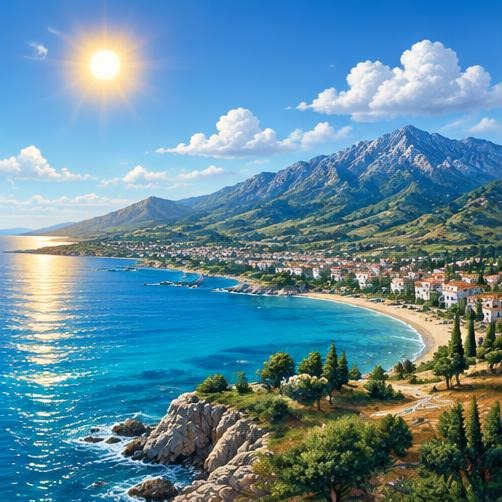
A water droplet's journey over Cyprus
Full worked example, no sign-up

A water droplet's journey over Cyprus

Science · Primary Year 5 · 45 minutes

One clear journey from sea to cloud and back, using a diagram, real rainfall data and active practice.

Grounded in established teaching research. The teacher stays in control of every document.

How the lesson unfolds for students

Guiding question

How can the same droplet be in the sea, a cloud and a mountain?

Follow the droplet

Does the droplet disappear when the sun warms it?

Show only the image first. Do not give the terms yet.

What we already know

  • What happens to a puddle after sunshine?
  • What are clouds made of?

Same substance, different form

Liquid water

  • Flows and collects.
  • Found in sea and rain.

Water vapour

  • It is a gas and rises.
  • We cannot easily see it.

The cycle in four steps

  1. 1Evaporation Water rises.
  2. 2Condensation Clouds form.
  3. 3Precipitation Water falls.
  4. 4Collection Water gathers.

Example: a droplet in Limassol

The sun warms a droplet in the sea. What follows?

  1. 1. It becomes vapour and rises.
  2. 2. It cools into a cloud droplet.
  3. 3. It falls as rain in Troodos.
  4. 4. It flows back to the sea.

Water changes place and state, but is not lost.

Quick check

Why does a cloud form?

  • Water vapour cools.
  • Rain warms up.
  • The sea freezes.

What we keep

  • The sun drives the cycle.
  • Water changes state.
  • The cycle repeats.

Exit ticket

Write the four stages in the correct order.

Begin with the sea and the sun.

Learning objectives

  1. 01

    I explain the four stages of the water cycle in the correct order.

Lesson plan, minute by minute

  1. 0 to 4 min

    Notice

    Show the Cyprus image. Students point to water and predict what may happen next.

  2. 4 to 10 min

    Recall

    Connect sun, water vapour, clouds and rain to familiar experiences.

  3. 10 to 20 min

    Teach

    Build the diagram together: evaporation, condensation, precipitation, collection.

  4. 20 to 28 min

    Guided example

    Trace one droplet and justify each change in one short sentence.

  5. 28 to 39 min

    Source task

    Students read rainfall data, complete the diagram and explain the journey in pairs.

  6. 39 to 45 min

    Check and exit

    One understanding check and an exit ticket with the four stages.

Sources and material

Cyprus Department of Meteorology, climatic rainfall data. https://dom.org.cy/CLIMATOLOGY/English/
USGS Water Science School, The Water Cycle. https://www.usgs.gov/special-topics/water-science-school/science/water-cycle

Differentiation and support

  • Colour coding and picture cards for every stage.
  • Instructions are given one at a time and read aloud.
  • Sentence scaffold: ‘The droplet now… because…’
  • Challenge: explain how temperature changes the cycle.

Slide deck for the classroom

16 slides, ready to project in class.

01 · Science · Primary Year 5

A water droplet's journey over Cyprus

    Sunlight warms the sea
    Sunlight warms the sea

    Slide 01 / 16 · A water droplet's journey over Cyprus

    Cinematic cover

    Ready-to-use test with answer key

    5 questions · 20 points

    1. 1. Short answer2 pts

      What energy drives the water cycle?

      Answer key: Heat energy from the sun.

    2. 2. Sequence4 pts

      Order these: collection, condensation, evaporation, precipitation.

      Answer key: Evaporation, condensation, precipitation, collection.

    3. 3. Explanation4 pts

      Why do droplets appear outside a cold glass?

      Answer key: Water vapour in the air cools and condenses.

    4. 4. Use of data4 pts

      Use the source. When does most water return to the ground?

      Answer key: In January, because average rainfall is 90 mm.

    5. 5. Extended response6 pts

      Explain a droplet's journey in four sentences.

      Answer key: One correct sentence for each stage in a clear cycle.

    Rubric (1 to 20 scale)

    Excellent (17 to 20)

    Explains the water cycle accurately, uses the diagram and supports the answer.

    Very good (13 to 16)

    Gives a correct explanation and uses most of the evidence.

    Secure (9 to 12)

    Identifies the main steps, but the connection needs development.

    Needs support (1 to 8)

    Identifies isolated details with visual or verbal support.

    CriterionExcellent (17 to 20)Very good (13 to 16)Secure (9 to 12)Needs support (1 to 8)
    Scientific accuracyExplains the sequence and changes of water correctly.One minor omission.Partly correct sequence.Needs a model.
    Use of the visual modelLinks every part with a clear reason.Uses the diagram correctly.Copies without a full explanation.Does not yet connect the parts.
    Use of sourceSelects and interprets one correct rainfall detail.Uses one correct detail.Refers to the source generally.Needs guidance with the source.

    Classroom activity

    Build the cycle

    12 minutes · Pairs

    Complete and explain a cycle without help.

    Steps

    1. 1.Read the rainfall data first.
    2. 2.Place the four stage cards.
    3. 3.Draw arrows and add one short explanation.
    4. 4.Explain the journey to your partner.

    Materials needed

    • • Stage cards
    • • Cycle sheet
    • • Colour pencils

    Differentiation

    • • Picture and first letter on each card.
    • • Ready learners add infiltration into soil.

    Pedagogical rationale: Placing, drawing and explaining make the process visible.

    Student worksheet

    Print-ready: warm-up, key words, tasks with real answer space, a self-check and an exit ticket.

    A water droplet's journey over Cyprus

    Classroom worksheetScience · Primary Year 5 · 25 min

    A water droplet's journey over Cyprus

    Name
    Class
    Date
    Score/ 10

    Follow one droplet. Use the source, then complete and explain the cycle.

    What I will be able to do

    • I can order the four stages.
    • I can explain each change.
    • I can use rainfall data.

    Key words

    Evaporation — Liquid water becomes vapour.
    Condensation — Vapour cools into droplets.
    Precipitation — Water falls from clouds.
    Collection — Water gathers on land or in the sea.

    Warm-up

    Answer in a few words.

    1. 1
      What happens to a puddle in sunshine?
    2. 2
      What are clouds made from?
    1

    Task 1: Read the rainfall source

    4 min

    Circle the wettest month and write the evidence.

    Example: January is wettest because it has 90 mm.

    Help: Find the largest number.

    Challenge: How much wetter is January than November?

    2

    Task 2: Build the cycle

    8 min

    Put the four stages in order and explain one change.

    Example: Evaporation, water warms and rises as vapour.

    StageWhat happens

    Help: Use the four keyword cards.

    Challenge: Add infiltration or transpiration.

    3

    Task 3: Explain the journey

    8 min

    Write four short sentences about a droplet travelling from the sea to Troodos and back.

    Example: The sun warms a droplet in the sea.

    Help: Start with: First, Next, Then, Finally.

    Challenge: Explain what provides the energy.

    Check before you hand in

    • My four stages are in order.
    • I explained one change of state.
    • I used one number from the source.

    Exit ticket

    Write the four stages in order.

    How did it go today?

    :-)Went great
    :-|Went okay
    :-(I found it hard

    More full examples