
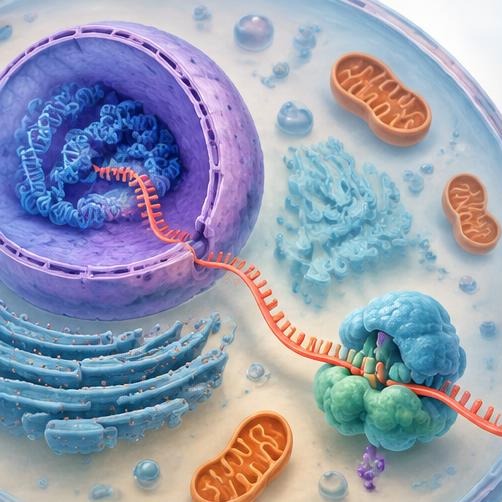
From DNA to protein
Full worked example, no sign-up

From DNA to protein

Biology · Upper Secondary Year 11 · 55 minutes

One precise molecular journey from gene to protein, with a visual model, codons and a complete worked example.

Grounded in established teaching research. The teacher stays in control of every document.

How the lesson unfolds for students

Guiding question

How does a sequence of four letters become a working molecule?

Follow the information

Does DNA leave the nucleus to make a protein?

What we already know

  • What are the complementary base rules in DNA?
  • Why does protein shape matter?

Two stages of gene expression

Transcription

  • Occurs in the nucleus.
  • Makes mRNA from DNA.

Translation

  • Occurs at a ribosome.
  • Makes an amino acid chain.

From gene to protein

  1. 1Gene opens The template strand is exposed.
  2. 2Transcription mRNA is formed.
  3. 3Exit mRNA leaves the nucleus.
  4. 4Translation The ribosome reads codons.
  5. 5Folding The chain gains shape.

Worked example

Template DNA: TAC CCG AAA ACT. Find the mRNA and amino acids.

  1. 1. TAC becomes AUG.
  2. 2. CCG becomes GGC.
  3. 3. AAA becomes UUU.
  4. 4. ACT becomes UGA.
  5. 5. AUG, GGC, UUU, UGA give Met, Gly, Phe, STOP.

First transcribe complementarily. Then read the codons.

Quick check

Which mRNA is produced from template DNA TAC?

  • AUG
  • TAC
  • UAC

What we keep

  • Transcription copies information into mRNA.
  • Translation reads codons.
  • Amino acid order determines the protein.

Exit ticket

Connect gene, mRNA, ribosome and protein in one sentence.

Use the verbs transcribed and translated.

Learning objectives

  1. 01

    I use transcription and translation to convert a short DNA segment into an amino acid sequence.

Lesson plan, minute by minute

  1. 0 to 5 min

    Hook

    Students inspect the image and identify what moves from nucleus to ribosome.

  2. 5 to 12 min

    Recall

    Recall complementary bases and the role of proteins.

  3. 12 to 22 min

    Transcription

    Model template DNA to mRNA, one base at a time.

  4. 22 to 32 min

    Translation

    Split mRNA into codons and use the genetic code table.

  5. 32 to 41 min

    Worked example

    The class solves one complete sequence and checks each decision.

  6. 41 to 51 min

    Independent practice

    Students solve a new sequence and explain what one mutation could change.

  7. 51 to 55 min

    Exit

    One sentence connects gene, mRNA, ribosome and protein.

Sources and material

OpenStax Biology 2e, Gene Expression. https://openstax.org/books/biology-2e/pages/15-introduction
NCBI, The Genetic Codes. https://www.ncbi.nlm.nih.gov/Taxonomy/Utils/wprintgc.cgi

Differentiation and support

  • Each molecule keeps a consistent colour and screen position.
  • The sequence is visually chunked into triplets.
  • An A, U, C, G rule card is provided.
  • Challenge: predict the effect of a base substitution.

Slide deck for the classroom

16 slides, ready to project in class.

01 · Biology · Upper Secondary Year 11

From DNA to protein

    Cell, nucleus, mRNA and ribosome
    Cell, nucleus, mRNA and ribosome

    Slide 01 / 16 · From DNA to protein

    Cinematic cover

    Ready-to-use test with answer key

    5 questions · 20 points

    1. 1. Recall2 pts

      Where does transcription occur in a eukaryotic cell?

      Answer key: In the nucleus.

    2. 2. Application3 pts

      Transcribe template DNA TAC into mRNA.

      Answer key: AUG.

    3. 3. Explanation3 pts

      What does the ribosome do?

      Answer key: It reads mRNA codons and links amino acids.

    4. 4. Use of source5 pts

      Use the source to translate AUG GGC UUU UGA.

      Answer key: Methionine, glycine, phenylalanine, stop.

    5. 5. Synthesis7 pts

      Explain how a base change can alter a protein.

      Answer key: It may change a codon, amino acid, folding and function. It may also be silent.

    Rubric (1 to 20 scale)

    Excellent (17 to 20)

    Explains gene expression accurately, uses the diagram and supports the answer.

    Very good (13 to 16)

    Gives a correct explanation and uses most of the evidence.

    Secure (9 to 12)

    Identifies the main steps, but the connection needs development.

    Needs support (1 to 8)

    Identifies isolated details with visual or verbal support.

    CriterionExcellent (17 to 20)Very good (13 to 16)Secure (9 to 12)Needs support (1 to 8)
    Scientific accuracyExplains transcription and translation correctly.One minor omission.Partly correct sequence.Needs a model.
    Use of the visual modelLinks every part with a clear reason.Uses the diagram correctly.Copies without a full explanation.Does not yet connect the parts.
    Use of sourceSelects and interprets the correct codon table.Uses one correct detail.Refers to the source generally.Needs guidance with the source.

    Classroom activity

    Decode the gene

    10 minutes · Individual, then pair check

    Transcribe and translate a new sequence with clear steps.

    Steps

    1. 1.Split template DNA into triplets.
    2. 2.Write complementary mRNA.
    3. 3.Use the codon table.
    4. 4.Check one codon with your partner.

    Materials needed

    • • Base rule card
    • • Codon table
    • • Sequence sheet

    Differentiation

    • • Triplets are pre-spaced and colour coded.
    • • Challenge: change one base and predict the result.

    Pedagogical rationale: The worked example reduces load before independent practice.

    Student worksheet

    Print-ready: warm-up, key words, tasks with real answer space, a self-check and an exit ticket.

    From DNA to protein

    Classroom worksheetBiology · Upper Secondary Year 11 · 27 min

    From DNA to protein

    Name
    Class
    Date
    Score/ 10

    Work through one sequence carefully. Transcribe first, then translate.

    What I will be able to do

    • I transcribe template DNA into mRNA.
    • I read mRNA in codons.
    • I use a codon source accurately.

    Key words

    Transcription — Making mRNA from a DNA template.
    Translation — Reading mRNA to build an amino acid chain.
    Codon — Three mRNA bases.
    Ribosome — The structure that translates mRNA.

    Warm-up

    Write the matching base.

    1. 1
      DNA A pairs with?
    2. 2
      In RNA, A pairs with?
    3. 3
      How many bases form a codon?
    1

    Task 1: Follow the worked example

    5 min

    Complete the missing mRNA codon for template DNA TAC CCG AAA ACT.

    Example: TAC becomes AUG.

    Help: Use T to A, A to U, C to G, G to C.

    Challenge: State which codon starts translation.

    2

    Task 2: Translate the message

    7 min

    Use the source table to name the amino acids.

    Example: AUG, methionine and START.

    mRNA codonMeaning

    Help: Match one codon at a time.

    Challenge: Explain why STOP is not an amino acid.

    3

    Task 3: Solve a new sequence

    10 min

    Transcribe and translate template DNA TAC TTT CCA ACT.

    Example: Step 1: split into triplets.

    Help: Write the mRNA directly beneath each DNA triplet.

    Challenge: Change one DNA base and predict the effect.

    Check before you hand in

    • I used U, not T, in mRNA.
    • I kept the triplet groups.
    • I used the mRNA codon table.

    Exit ticket

    Connect gene, mRNA, ribosome and protein in one sentence.

    How did it go today?

    :-)Went great
    :-|Went okay
    :-(I found it hard

    More full examples