
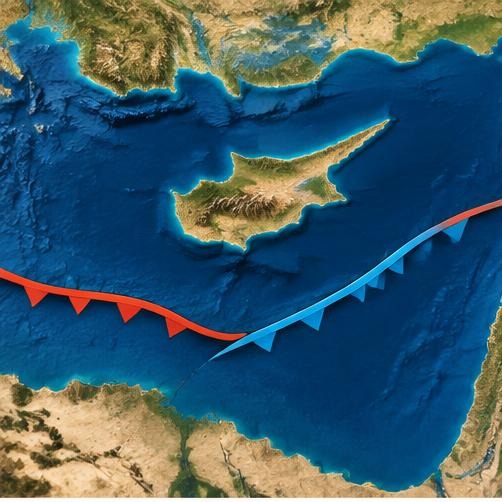
Why do earthquakes happen in Cyprus?
Full worked example, no sign-up

Why do earthquakes happen in Cyprus?

Geography · Lower Secondary Year 8 · 50 minutes

From plate motion to seismic waves, using a cutaway, a Cyprus map and an authentic earthquake record.

Grounded in established teaching research. The teacher stays in control of every document.

How the lesson unfolds for students

Guiding question

How can slow plate movement cause sudden shaking?

Look beneath the island

Which part of the image shows that the ground is not still?

What we already know

  • What is the difference between crust and mantle?
  • What does a wave transfer?

Two points in one earthquake

Focus

  • Rupture begins inside Earth.
  • It has a depth.

Epicentre

  • Point on the surface.
  • Located above the focus.

From movement to shaking

  1. 1Movement Plates move.
  2. 2Friction The fault locks.
  3. 3Stress Energy is stored.
  4. 4Rupture Rock slips.
  5. 5Waves The ground shakes.

Example: read the bulletin

Which details describe location and which describe strength?

  1. 1. The epicentre gives the surface location.
  2. 2. 18 km gives focus depth.
  3. 3. 4.2 gives magnitude.

Magnitude, depth and epicentre answer different questions.

Quick check

Where does rupture begin?

  • At the focus.
  • At the epicentre.
  • Always in the mantle.

What we keep

  • Plates move continuously.
  • Friction stores stress.
  • Rupture sends seismic waves.

Exit ticket

Explain in two sentences why Cyprus has earthquakes.

Use: plates, stress, rupture.

Learning objectives

  1. 01

    I explain how plate movement stores and releases energy near Cyprus.

Lesson plan, minute by minute

  1. 0 to 5 min

    Hook

    Students inspect the cutaway and locate where plates appear to meet.

  2. 5 to 12 min

    Recall

    Distinguish crust, mantle and tectonic plate with three short questions.

  3. 12 to 24 min

    Model

    Build the sequence: movement, friction, stress, rupture, seismic waves.

  4. 24 to 32 min

    Guided reading

    Read a simplified earthquake bulletin and model how to locate the epicentre.

  5. 32 to 44 min

    Apply

    In pairs, students connect the seismogram to plate movement and write one causal explanation.

  6. 44 to 50 min

    Check

    Individual question: why does Cyprus face earthquake risk?

Sources and material

Geological Survey Department of Cyprus, seismological data. https://www.moa.gov.cy/moa/gsd/gsd.nsf/page17_en/page17_en
USGS Earthquake Hazards Program. https://www.usgs.gov/programs/earthquake-hazards/science-earthquakes

Differentiation and support

  • The sequence uses five consistent icons.
  • Source text is chunked with bold key words.
  • Sentence scaffold: ‘The plates…, so stress…’
  • Challenge: compare focus and epicentre.

Slide deck for the classroom

16 slides, ready to project in class.

01 · Geography · Lower Secondary Year 8

Why do earthquakes happen in Cyprus?

    Plate cutaway beneath Cyprus
    Plate cutaway beneath Cyprus

    Slide 01 / 16 · Why do earthquakes happen in Cyprus?

    Cinematic cover

    Ready-to-use test with answer key

    5 questions · 20 points

    1. 1. Definition2 pts

      What is an earthquake focus?

      Answer key: The point inside Earth where rupture begins.

    2. 2. Sequence5 pts

      Order: waves, friction, rupture, movement, stress.

      Answer key: Movement, friction, stress, rupture, waves.

    3. 3. Compare4 pts

      What is the difference between focus and epicentre?

      Answer key: The focus is inside Earth. The epicentre is on the surface above it.

    4. 4. Use of source3 pts

      What do the 18 km in the source tell us?

      Answer key: The depth of the focus.

    5. 5. Causal explanation6 pts

      Explain why slow movement can produce sudden shaking.

      Answer key: Friction locks the fault, stress builds and when rock slips the energy is released as waves.

    Rubric (1 to 20 scale)

    Excellent (17 to 20)

    Explains earthquake formation accurately, uses the diagram and supports the answer.

    Very good (13 to 16)

    Gives a correct explanation and uses most of the evidence.

    Secure (9 to 12)

    Identifies the main steps, but the connection needs development.

    Needs support (1 to 8)

    Identifies isolated details with visual or verbal support.

    CriterionExcellent (17 to 20)Very good (13 to 16)Secure (9 to 12)Needs support (1 to 8)
    Scientific accuracyExplains movement, stress and rupture correctly.One minor omission.Partly correct sequence.Needs a model.
    Use of the visual modelLinks every part with a clear reason.Uses the diagram correctly.Copies without a full explanation.Does not yet connect the parts.
    Use of sourceSelects and interprets one accurate bulletin detail.Uses one correct detail.Refers to the source generally.Needs guidance with the source.

    Classroom activity

    From bulletin to explanation

    12 minutes · Pairs then individual response

    Use the bulletin and cutaway to explain the earthquake.

    Steps

    1. 1.Read the bulletin and circle location, depth and magnitude.
    2. 2.Mark focus and epicentre on the cutaway.
    3. 3.Match the five stages.
    4. 4.Write one causal explanation.

    Materials needed

    • • Earthquake bulletin
    • • Geological cutaway
    • • Stage cards

    Differentiation

    • • Movement, stress and rupture are provided.
    • • Challenge: explain why depth affects surface shaking.

    Pedagogical rationale: The source supplies evidence and the diagram explains the mechanism.

    Student worksheet

    Print-ready: warm-up, key words, tasks with real answer space, a self-check and an exit ticket.

    Why do earthquakes happen in Cyprus?

    Classroom worksheetGeography · Lower Secondary Year 8 · 26 min

    Why do earthquakes happen in Cyprus?

    Name
    Class
    Date
    Score/ 10

    Use the bulletin and cutaway to connect plate movement to ground shaking.

    What I will be able to do

    • I can order the earthquake mechanism.
    • I distinguish focus and epicentre.
    • I use bulletin data as evidence.

    Key words

    Stress — Force stored in deformed rock.
    Fault — A fracture where rock can move.
    Focus — Where rupture begins inside Earth.
    Epicentre — Surface point above the focus.

    Warm-up

    Recall two ideas.

    1. 1
      What is a tectonic plate?
    2. 2
      What does a wave transfer?
    1

    Task 1: Read the bulletin

    5 min

    Sort location, depth and magnitude into the table.

    Example: Depth, 18 km, where the focus lies.

    DetailValueWhat it tells us

    Help: Underline each number and place name.

    Challenge: Explain which detail does not measure damage.

    2

    Task 2: Build the mechanism

    7 min

    Order the five stages from plate movement to shaking.

    Example: Movement begins, but friction locks the fault.

    Help: Use the stage cards.

    Challenge: Add where energy is stored and released.

    3

    Task 3: Explain Cyprus

    9 min

    Use the cutaway and one bulletin detail to explain why Cyprus has earthquakes.

    Example: Cyprus lies near moving plates, so stress can build along faults.

    Help: Use: plates, friction, stress, rupture.

    Challenge: Distinguish hazard from damage.

    Check before you hand in

    • My sequence has five linked stages.
    • I used focus and epicentre correctly.
    • I included one source detail.

    Exit ticket

    Why can slow plate motion cause sudden shaking?

    How did it go today?

    :-)Went great
    :-|Went okay
    :-(I found it hard

    More full examples